

By Dean Aubrey Caratiquet
With the disharmony of various issues emanating from the higher ups of the government in recent years, one may have noticed a constant pattern of non-interference between its three branches amid the citizenry’s clamor for unison among elected officials.
But why are these departments continuing to work almost exclusively independently of each other, except in certain circumstances?
The answer to this nuanced question lies in the principle of separation of powers—a doctrine that calls for the creation of an executive, legislative, and judicial branch of government to maintain checks and balances.
This safeguard enshrined in the 1987 Constitution acts as an invisible barrier that ensures each entity does not overstep each other’s responsibilities and vested interests, working akin to the U.S. Constitution, from which it is largely based.
The Legislative Department
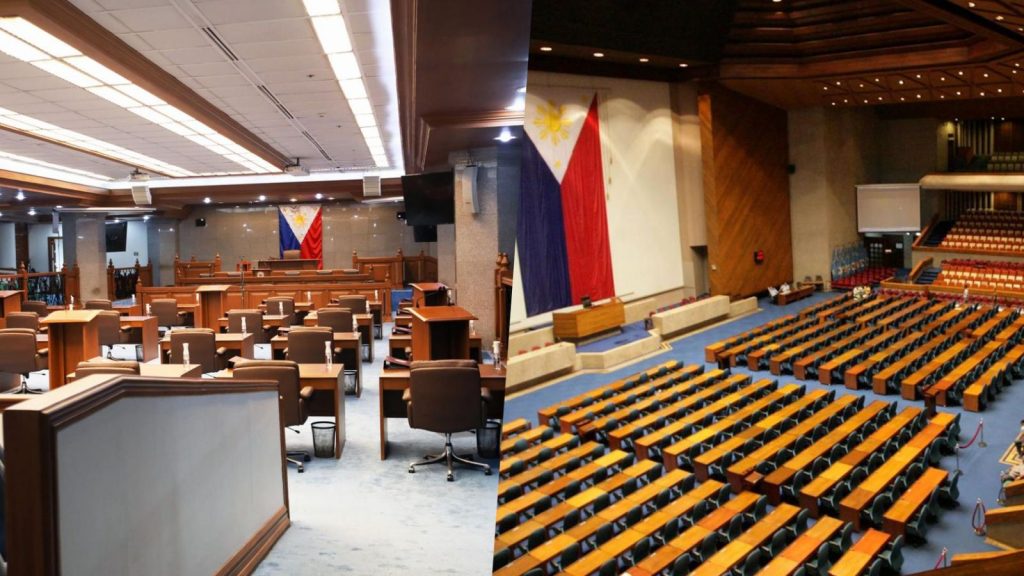
In Article VI of the 1987 Constitution, the Congress forms the backbone of the legislative department, which consists of the Senate and the House of Representatives.
The former serves as the upper chamber of the bicameral legislative framework, composed of 24 senators duly elected by the voting population—with 4 of them serving roles as officers through the following positions: Senate President, Senate President Pro Tempore, Majority Leader, and Minority Leader.
In that vein, the Senate carries the mandate of exercising oversight and upholding accountability in hearings conducted by any of its committees on pressing national issues, on top of other duties which include:
- Lawmaking
- Budget approval
- Confirmation of appointments
- Managing impeachment proceedings
The latter, on the other hand, serves as the lower chamber’s counterpart, composed of 250 or more representatives hailing from party-lists, major cities, and provinces across the country under the leadership of a House Speaker.
The House of Representatives therefore, represents the interests of Filipinos in the country’s legislature, with lawmakers raising issues brought up by their constituents and the marginalized and underrepresented sectors to national awareness—effectively transmitting the voices of public interest to other branches of government for further deliberation and resolution.
The Executive Department
Serving as the top component of the three branches of government, the President wields his/her power not only as the nation’s top government official but also as the top brass of the executive branch.
Four key officials—namely the Executive Secretary, Special Assistant to the President, Chief Presidential Legal Counsel, and Presidential Management Staff—fulfill their duties by directly reporting to the President. The first two can also represent the President in certain ceremonial engagements, too.
The President carries the mandate of serving the interests of Filipinos in tandem with a Vice-President, who may also be appointed as a member of the Cabinet.
Moreover, the Chief Executive supervises the 23 departments of the government through their respective Secretaries, as well as key offices including the Presidential Communications Office (PCO), Technical Education and Skills Development Authority (TESDA), and the Philippine National Police (PNP).
As the primary figure representing the Philippines on the local and international stage, the President’s mandate lies in ensuring that all sectors work toward the betterment of the constituents, and keeps the Southeast Asian nation in rapport with allied nations.
The Judicial Department
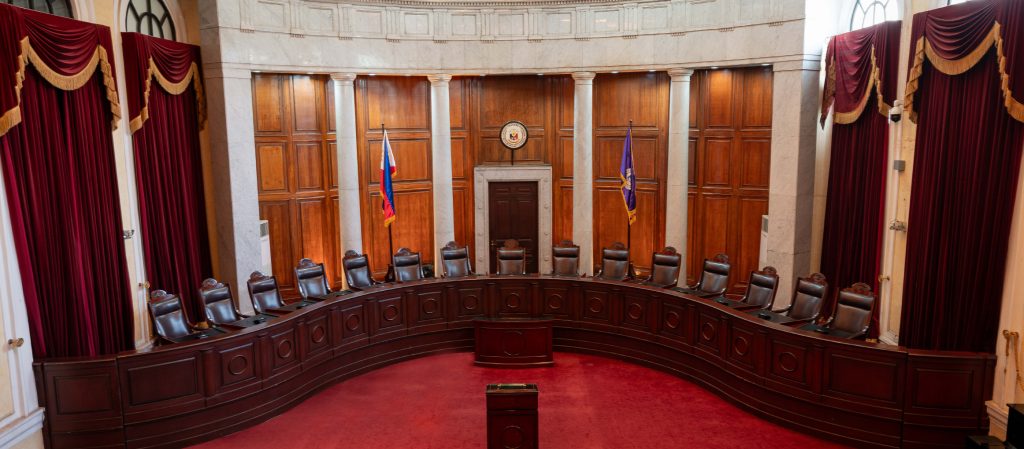
Rounding up the trifecta is the judicial branch, with the Supreme Court wielding the power to ensure that justice benefits everyone—irrespective of social class, financial status, educational background, and other such classifications.
Composed of a Chief Justice and 14 associate justices which may conduct hearings en banc or in divisions of three, five, or seven members, the high court decides on cases or matters concerning controversies and other issues concerning government officials.
The Supreme Court uses its administrative authority to uphold the 1987 Constitution, due process, writ of habeas corpus, and human rights in deciding the outcome of cases to avoid a miscarriage of justice.
Section 8, Article VII of the 1987 Constitution added, “A Judicial and Bar Council is hereby created under the supervision of the Supreme Court composed of the Chief Justice as ex officio Chairman, the Secretary of Justice, and a representative of the Congress as ex officio Members, a representative of the Integrated Bar, a professor of law, a retired Member of the Supreme Court, and a representative of the private sector.”
Through the Judicial and Bar Council and the Integrated Bar of the Philippines, the high court can also fulfill its mandate of equity through duly-licensed law practitioners working independently, at law firms, or offering their legal services for free through the Public Attorney’s Office.

How to make sense of it all?
In summary, each branch of the government fulfills its mandate as enshrined in the 1987 Constitution to ensure the unimpeded delivery of government services and implementation of government programs and initiatives to its constituents.
Whereas the legislative branch wields the power to make laws, the executive branch enforces the laws, and the judicial branch interprets laws in accordance with what is right and just.
Keeping all of these departments running as mostly separate entities ensures that the power to rule over citizens is distributed accordingly and does not remain in the hands of very few individuals, especially of particular importance when running an archipelagic nation like the Philippines.
This also means that when dealing with particularly charged and loaded topics that are of pressing national concern and are detrimental to the government, each branch is mostly left to its own discretion to properly settle such matters and ensure that Filipinos are largely shielded from the repercussions of these worrying developments.
avds/jpv

