
The Department of Health (DOH) said the decision for the next quarantine classifications remains dependent on metrics used by the Inter-Agency Task Force for the Management of Emerging Infectious Diseases (IATF-EID).
DOH USec. Leopoldo Vega said in the Aug. 10 Palace briefing that the two-week growth rate (2WGR) of cases, or the percentage change from cases of the previous two weeks compared to cases of the previous three to four weeks, must be lowered.
“Pangalawa, iyong ADAR [average daily attack rate] po natin, pababain po natin so that hindi naman masyadong maging highly — ang transmission ay hindi tataas,” Vega said.
“Dapat naman low-risk ang category dapat ng ating HCUR [healthcare utilization rate] lalung-lalo na dito sa Metro Manila. Siguro kung ganoon, baka ang IATF ay mag-deescalate na kung makikita nila itong metric na ito,” Vega added.
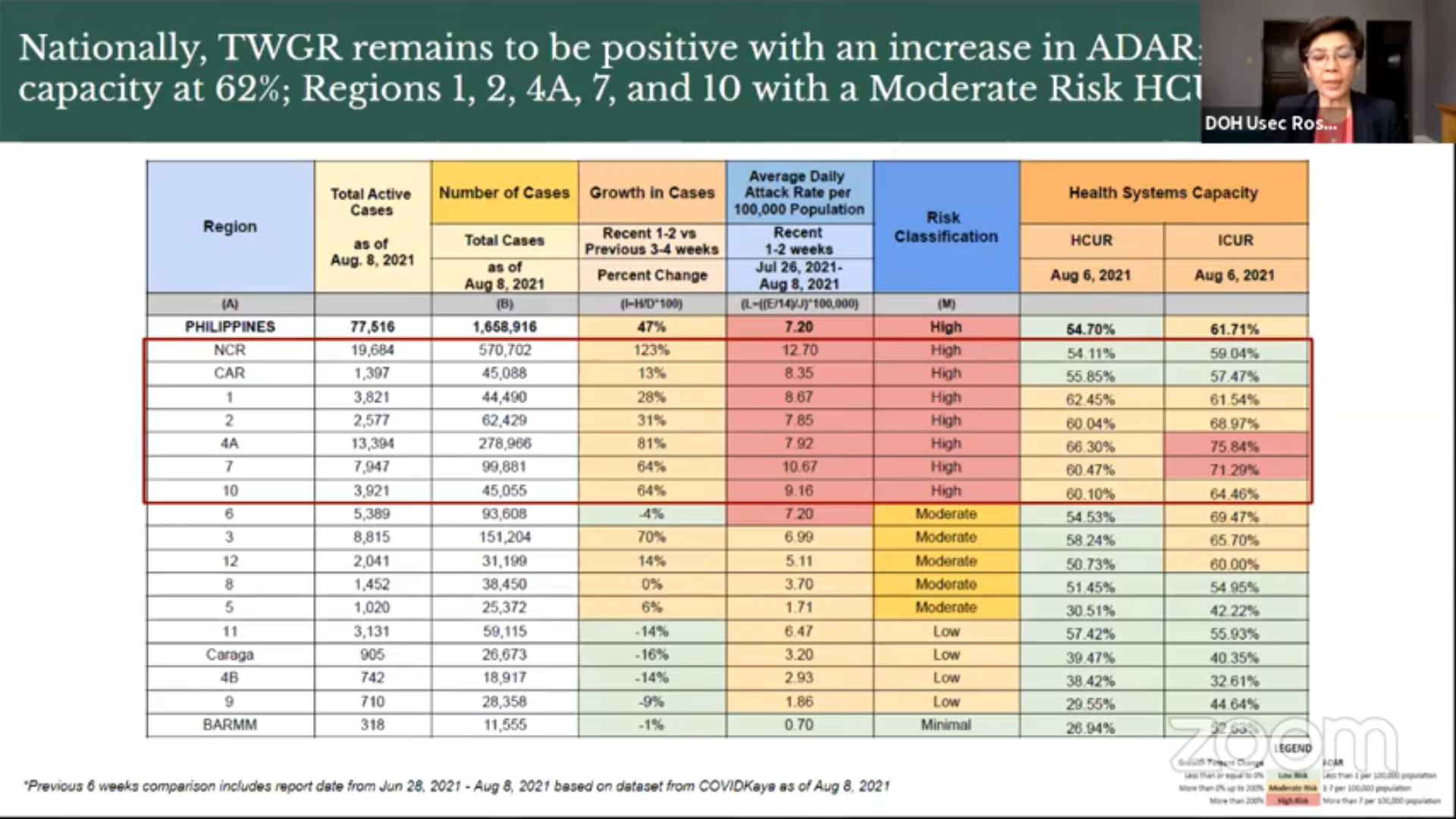
The Philippines was recently reverted to high risk classification for COVID-19 with an ADAR of 7.20 per 100,000 population and a 2WGR of 47% as of Aug. 8. The positivity rate on Aug. 9 also rose to 21.3% from the 20.3% on Aug. 8.
The NCR was likewise included in the high risk category, with a 123% 2WGR, and ADAR of 12.70 per 100,000 population.
The OCTA Research Group said the reproduction number (R0) of the country rose to 1.33, while Metro Manila’s R0 increased to 1.79. The latter’s seven-day moving average on Aug. 3 to 9 rose by 41%.
OCTA also observed an increase in intensive care unit (ICU) utilization, with the nationwide figures at 65% and NCR at 67%.
The Philippine Hospital Association (PHA) said they would want the prevailing enhanced community quarantine (ECQ) in the National Capital Region (NCR) to be extended amid increasing cases and rising hospital occupancy rates.
“Gusto namin na ma-extend dahil ‘yan naman ang effective way to contain ‘yung spread ng sakit, pero we know that ‘yung reason for not extending is also equally valid,” PHA Pres. Dr. Jaime Almora said in an interview with PTV.
Almora said the ECQ “should be more an effort of the people,” and that they should refrain from going out when not necessary.
“‘Yung mga tao mismo ang nag-iisip na hindi sila lalabas sa mga bahay nila kung kaya nilang hindi lumabas. Dahil kung magkasakit sila, baka wala na silang mapuntahang ospital,” Almora said.
Metro Manila’s ECQ is expected to end on Aug. 20. – Report from Mark Fetalco/AG-rir
Watch full report here:

