
By Anna Leah Gonzales | Philippine News Agency
The government will ramp up efforts to address the impact of the Middle East conflict and will continue to push for reforms to boost economic growth, the Department of Economy, Planning, and Development (DEPDev) said.
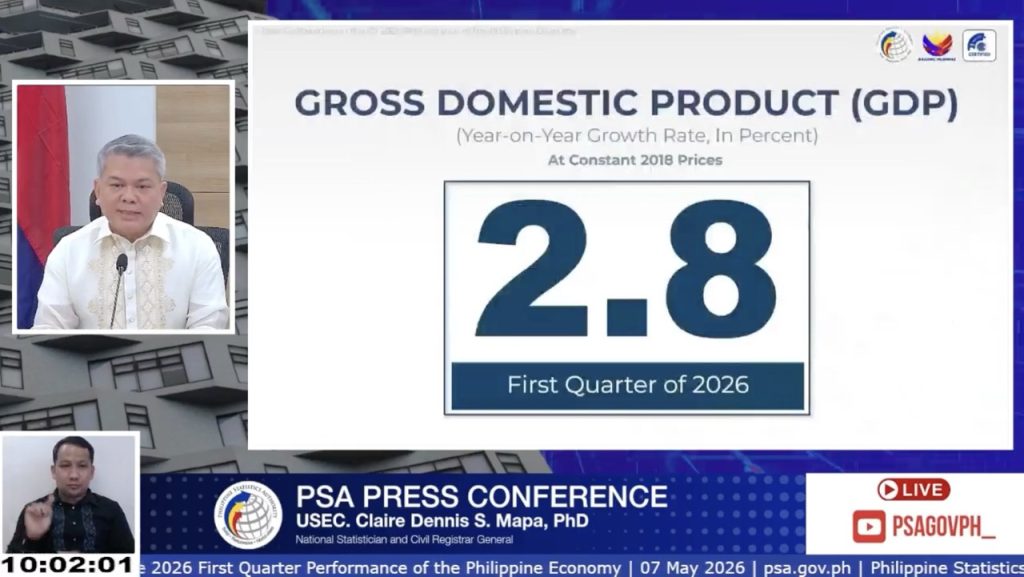
Philippine economic growth slowed to 2.8% in the first quarter of the year from 3% in the fourth quarter of 2025.
Philippine Statistics Authority (PSA) Undersecretary and National Statistician Dennis Mapa said that among the major economic sectors, services grew by 4.5%.
Agriculture, forestry, and fishing, however, declined by 0.2%, while industry also contracted by 0.1%.
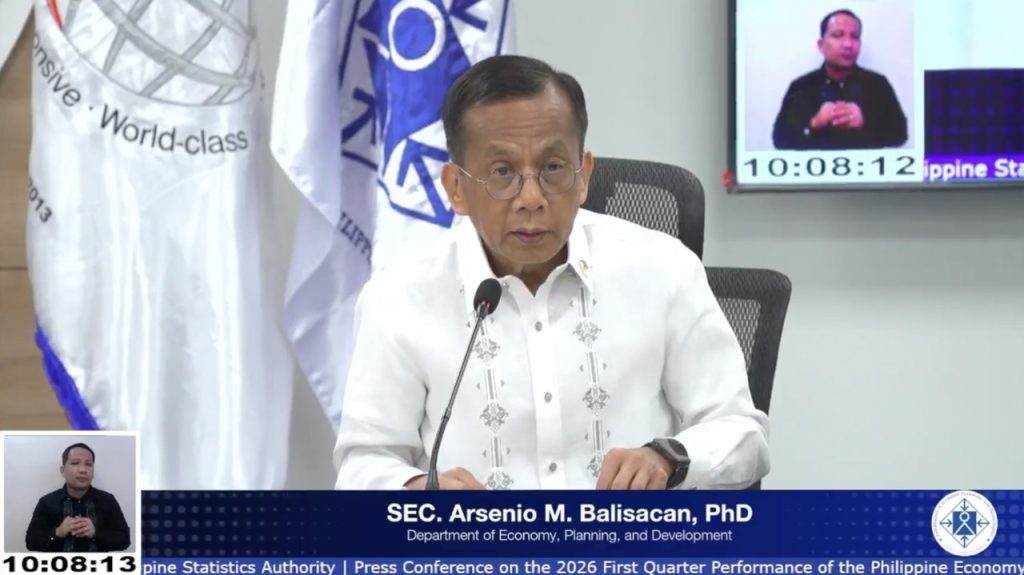
In a briefing at the PSA’s office in Quezon City on Thursday, DEPDev Secretary Arsenio Balisacan acknowledged that the latest growth data “reflects the combined impact of significant domestic and global challenges.”
Balisacan said these include the lingering effects of the flood control corruption controversy, which weighed on consumer sentiment and business and investment confidence.
Household final consumption expenditure slowed year on year to 3% from 5.3%, while gross capital formation declined by 3.3%.
Balisacan said delays in the passage and release of the 2026 national budget slowed the rollout of critical government programs and infrastructure projects.
“Third and foremost, the conflict in the Middle East, which escalated toward the end of February, triggered higher global oil prices and renewed supply chain pressures, creating additional risks for oil-importing economies, such as the Philippines,” he said.
“These challenges are real, and the Marcos administration is confronting them directly and decisively.”
Balisacan said the administration is addressing corruption to restore consumer and business confidence.
The government is also pursuing reforms to improve transparency, accountability, and efficiency in government services.
Because government expenditure also slowed in the first quarter, Balisacan said, the President directed implementing agencies to accelerate the execution of high-impact infrastructure projects in the coming months.
“We can’t also blame our agencies because they are so extremely careful to assure that there is no corruption associated with a project. But I think things have moved much faster compared to the time when this (flood control) issue first popped up,” he said.
“We expect government spending and project implementation to accelerate in the coming months as agencies operationalize their catch-up programs.”
Balisacan, however, assured that the government will enforce stricter validation standards and more rigorous monitoring systems to ensure that public resources are used efficiently, responsibly, and transparently.
In terms of addressing the impact of the oil price shock, Balisacan said the government’s Unified Package for Livelihoods, Industry, Food, and Transport (UPLIFT) brings together coordinated and targeted measures.
The government is also preparing for the possible effects of the developing El Niño phenomenon, he said.
Balisacan said DEPDev backs the reactivation of the El Niño Task Force to ensure a coordinated national response.
“Our focus will be on sound water and irrigation management, ensuring the reliability of critical infrastructure, and strengthening climate risk mapping and weather forecasting to support timely and science-based interventions,” he said.
Balisacan is also banking on the continued growth of exports to boost economic growth.
“Our semiconductor and electronics exports are expected to remain resilient, supported by sustained global demand and continuing tariff exemptions,” he said.
“While uncertainties remain, we are guided by sound economic fundamentals, clear policy direction, vision and push for structural reforms and our shared commitment to improving the lives of every Filipino.”
Reviewing targets
While the government is committed to easing the impact of the Middle East conflict, Balisacan said, the economic team may revise the growth targets.
“The combination of events, both domestic and global, is likely to reduce the growth, not just in the Philippines but many other countries,” he said.
The Development Budget Coordination Committee is scheduled to meet next week to review the country’s growth and fiscal targets.
The DBCC earlier set a 5–6% economic growth target for this year.
“We don’t expect to achieve the kind of growth that we expected to happen a year ago given recent developments,” Balisacan said.
“We definitely will move our targets lower because given the situation, especially the global uncertainty remaining highly elevated, our pre-Middle East conflict assumptions would no longer hold.”

