
By Dean Aubrey Caratiquet
Not long after decades of tension between Thailand and Cambodia boiled over in 2025 and resulted in months of trading gunfire and heavy artillery that displaced their respective residents and caused mounting casualties, ASEAN served as a conduit for both countries to reaffirm their commitment to long-lasting peace.
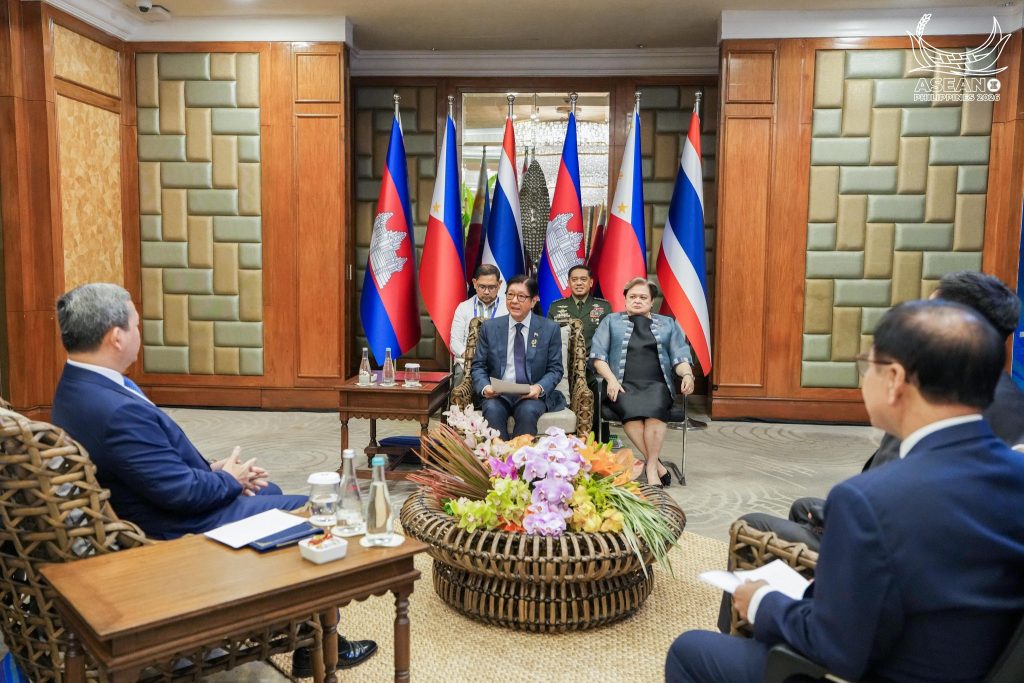
This, as President Ferdinand R. Marcos Jr. led a trilateral meeting between the Philippines, Thailand, and Cambodia at the sidelines of the 48th Association of Southeast Asian Nations (ASEAN) Summit held in Cebu City on May 7.
As the host country for the annual regional Summit, the President and his delegation served as the mediator between Cambodia Prime Minister Hun Manet and his Thai counterpart, Anutin Charnvirakul.
PM Manet said in a statement, “The Philippines constructive leadership in promoting regional peace, stability, and unity is commendable.
PM Charnvirakul declared, “It is best that we avoid conflict, it only brings losses and suffering. Now is the time for us to look forward and walk this path together towards peace.”
To conclude the meeting, the representatives of both countries reaffirmed their commitment to open communication, restraint, and the resumption of existing bilateral mechanisms, with a forward-looking view on ending the conflict that ignited at the border of the neighboring Southeast Asian nations.
A noteworthy deed
Meanwhile, a political analyst expressed high regard for the initiative of President Marcos Jr. to settle the differences between Bangkok and Phnom Penh, which reflects the message of unity that keeps the 11-member regional bloc together.
In an interview, UST Faculty of Arts and Letters Professor Dr. Froilan Calilung praised the timeliness of the Chief Executive’s mediation efforts, which showcase the country’s readiness to tackle problems that may deter investors from making investments in the Philippines and other ASEAN member states.
Dr. Calilung hailed the President’s showcase of leadership, “What the President is showing here is that he understands how diplomacy works, he knows where to align himself in line with forging meaningful international relations especially with like-minded countries.
He is also giving the impression na ang gusto natin ay continuity of economic programs and economic reforms. Mas nagkakaroon tayo ng kumpiyansa na maglatag ng investment mechanisms sa ibang bansa, knowing fully well that the image of the country is good, or at the very least, the reputation of the President is actually well accepted.”
The political analyst concluded that the fruits of the trilateral meeting send a strong signal on dealing with armed conflicts through peaceful means, which bodes well for fostering camaraderie and expanding avenues for productivity among ASEAN member states.
“What the President is trying to tell us here is that we need to avert conflict, because averting conflict is a necessary way for us to be able to achieve development. And if we want progress as a country and as a region, then we should be focused on these things and not the other way around.” (with report from Clay Pardilla | PTV News)
jpv

