
By Brian Campued
In line with the directive of President Ferdinand R. Marcos Jr. to embed transit-oriented development (TOD) principles in major transport infrastructure projects in the country, the Department of Transportation (DOTr), Department of Education (DepEd), and British Embassy Manila have completed the feasibility study for the proposed 13-hectare transit-oriented complex in Taguig City.
Strategically positioned at the junction of the forthcoming North-South Commuter Railway (NSCR) and Metro Manila Subway Project (MSSP), the Senate-DepEd Transit Oriented Development (SEED TOD) project seeks to improve urban mobility and foster inclusive, sustainable economic growth.
The project aims to reduce the transfer route between NSCR and MSSP lines from 900 meters to 200 meters, cutting transfer time by around 17 minutes.
More than the expected ease in travel, the SEED TOD project will also host education and research institutions while offering approximately 497,663 square meters of gross floor area for commercial; cultural; meetings, incentives, conferences and exhibitions; and community uses.
Designed with a car-free core, 59% of the site is reserved for publicly accessible pedestrian space, featuring covered walkways and elevated high-walks positioned above 50-year flood levels.
In a news release Wednesday, DOTr Secretary Giovanni Lopez said the project will demonstrate how education, residential, and commercial spaces can coexist around transit modes, creating an environment where “students spend less time commuting and more time studying, where families have genuine mobility choices and where the city itself becomes more livable and sustainable.”
As the project’s major landowner and co-grantor, the DepEd, through the leadership of Education Secretary Sonny Angara, committed to creating “greener, more livable learning environments” in highly urbanized areas by integrating parks, open spaces, and urban greenery into school communities.
Meanwhile, Department of Economy, Planning, and Development (DEPDev) Secretary Arsenio Balisacan said that aside from substantial improvements in connectivity, the study identifies prospects for job creation and opportunities for public-private partnerships.
British Ambassador to the Philippines Sarah Hulton OBE likewise commended the Philippine government for its collaboration with the UK as the two nations marked their 80th anniversary of diplomatic relations last July 4.
“For the UK, these projects align very closely with our broad objective of working in partnership with the Philippines to foster sustainable economic growth through high-quality infrastructure, stronger institutions, and deeper economic partnerships,” Ambassador Hulton said.

The feasibility study, which was started in November 2024, was funded by the United Kingdom government through its Green Cities, Infrastructure and Energy Programme (GCIEP), with Crossrail International serving as masterplanning consultant and the Public-Private Partnership Center providing technical assistance.
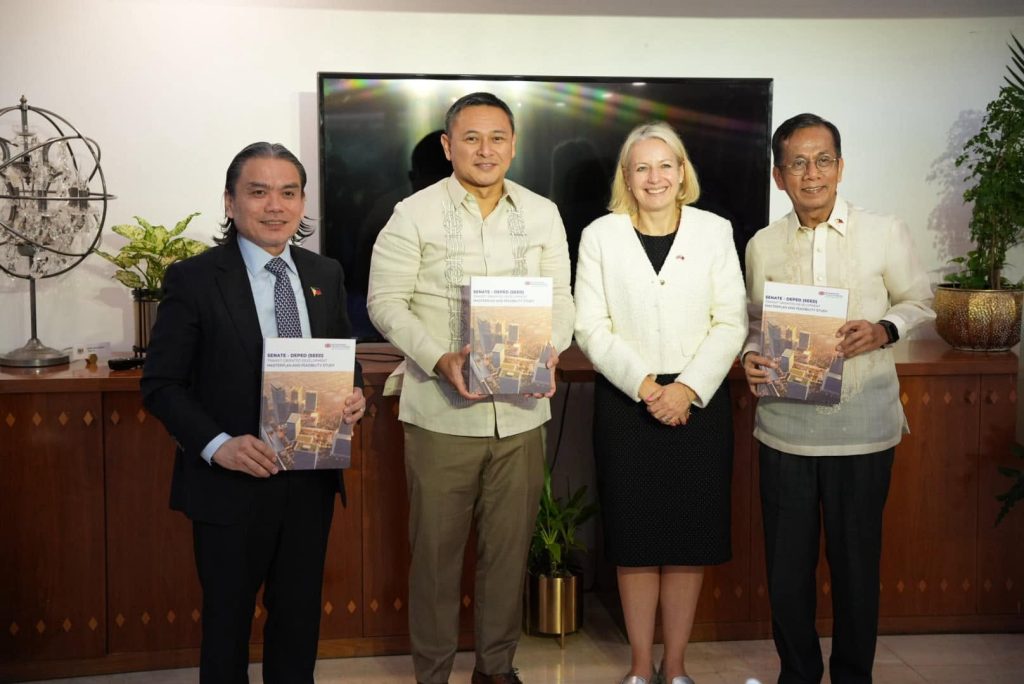
The completed assessment was formally turned over by the British Embassy Manila during the United Kingdom’s Infrastructure Projects Handover and Closing Ceremony on Tuesday, Aug. 4.
Aside from the SEED TOD Feasibility Study, the UK’s GCIEP also partnered with Philippine government agencies to produce the TOD Inter-Agency Framework, Water Tariff Policy Studies, Baguio Bulk Water Supply Feasibility Study, and Baguio City ISO 37001 Anti-Bribery Management System Roadmap.
The memorandum of understanding (MOU) for the development of the Taguig transit hub dubbed as the “Education City” was signed on July 21, 2025 by then-DOTr Secretary Vince Dizon, Angara, and former British Ambassador to the Philippines Laure Beaufils.
The SEED Project is also seen to contribute to the advancement of the Luzon Economic Corridor, a multilateral initiative aimed at accelerating strategic investments in infrastructure, logistics, and economic connectivity in the Philippines’ largest island.
-jpv

