
By Dean Aubrey Caratiquet
As developments in the Middle East soldier on with seemingly no end in sight, the ensuing global energy crisis and disruption to the supply chain continue to affect countries making transactions with nations situated in this region.
Among these is the Philippines, which continues to bear the brunt of expensive fuels due to supply bottlenecks—which itself continues to influence the prices of commodities on supermarket shelves.
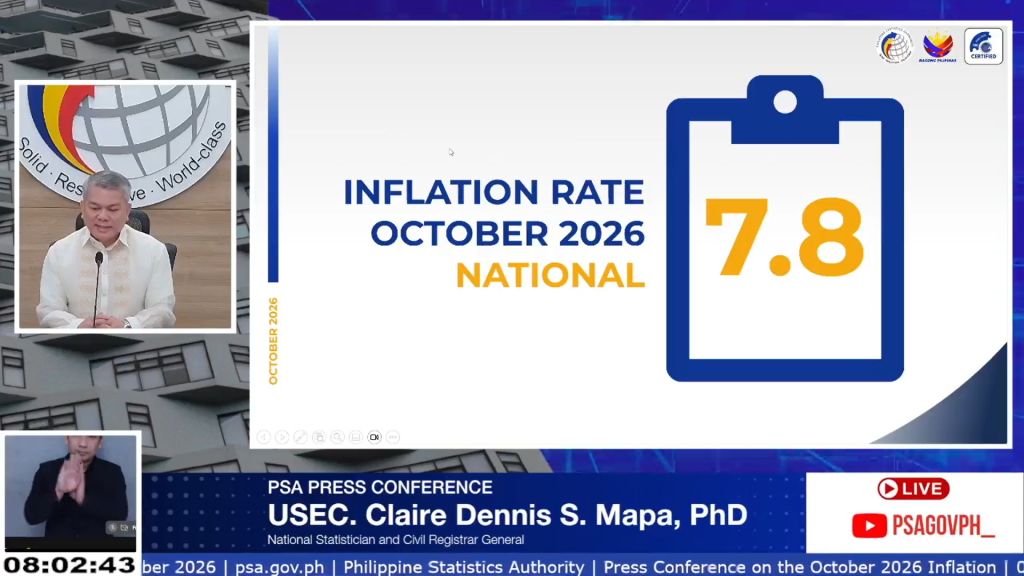
These realities are reflected in the October 2026 headline inflation figure recorded by the Philippine Statistics Authority (PSA), which rose to 7.8% from 7.2% in September 2026.
In a press conference Thursday, National Statistician Claire Dennis Mapa attributed the higher inflation percentage as a byproduct of faster annual increases in these commodity groups: food and non-alcoholic beverages; housing, water, electricity, gas, and other fuels; and transportation.
Among the other commodity groups that contributed to the headline inflation were:
a. Alcoholic beverages and tobacco (6.6% from 6.5%)
b. Clothing and footwear (3.4% from 3.3%)
c. Furnishings, household equipment and routine household maintenance (5.0% from 4.7%)
d. Health (5.9% from 5.6%)
e. Recreation, sport and culture (5.4% from 5.3%)
f. Restaurants and accommodation services (7.7% from 7.0%)
g. Personal care and miscellaneous goods and services (4.3% from 4.1%)
Meanwhile, the inflation rate observed in the National Capital Region also mirrored the headline inflation figure, pegged at 5.9% in October 2026, which is up from 5.3% in the previous month.
For areas outside of NCR, overall inflation accelerated to 8.2% in October 2026, up from 7.6% in September 2026.
jpv

