
By Christopher Lloyd Caliwan | Philippine News Agency
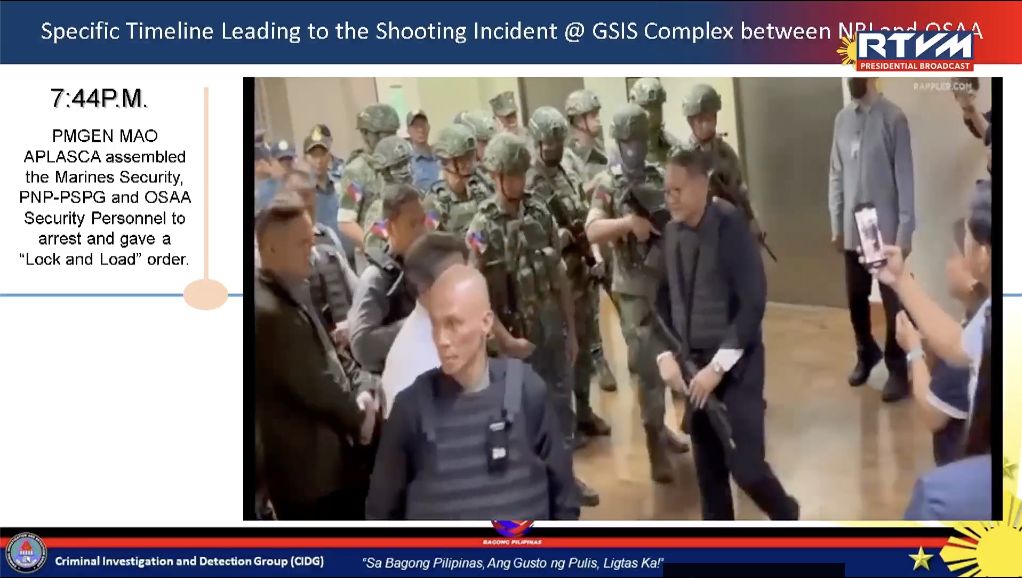
Police on Wednesday recommended the filing of charges against suspended acting Office of the Senate Sergeant-at-Arms (OSAA) chief Mao Aplasca in connection with last week’s shooting incident at the Senate building.
In a press briefing, Criminal Investigation and Detection Group (CIDG) director PMGen. Robert AA Morico II said criminal complaints would be filed against Aplasca and at least two of his men who were found to have discharged their firearms during the controversial May 13 incident.
Morico said the actions of Aplasca and his personnel constituted a clear violation of the Implementing Rules and Regulations (IRR) of Republic Act 11917, or the Private Security Services Industry Act, which was enacted in 2022 during the term of then-Senate President Vicente Sotto III.
According to Morico, the IRR of RA 11917 clearly states that a warning shot is not included in the six stages that need to be observed before the use of lethal force.
Under the IRR of RA 11917, private security personnel are required to follow a six-level “force continuum”: alert presence (Level 1); verbal communication (Level 2); physical restraints (Level 3); use of chemical agents (Level 4); temporary incapacitation (Level 5); and use of force or firearms (Level 6).
The IRR further states that firearms “shall be used only when there is imminent danger and in self-defense or defense of strangers.”
“We will be transmitting our findings to the DOJ (Department of Justice),” Morico said. “It is up to the DOJ to assess.”
Morico said the CIDG investigation found that there was no actual threat at the Senate during the incident and that the actions taken by the OSAA contradicted basic security protocols for responding to an alleged attack.
“It is very clear in our investigation that there was no attack in the Senate, there was no intent. In fact, if there is really a perceived ongoing attack, why did they abandon the area where the shooting happened?” he said.
According to Morico, what happened could be a case of “panic firing” on the part of the OSAA personnel.
“Ang problema, we call this ‘panic firing.’ You assumed na nilulusob kayo (that you are under attack),” he said.
Morico added that investigators are now trying to determine who may have provided Aplasca with information that agents from the National Bureau of Investigation (NBI) were allegedly preparing to storm the Senate to arrest Sen. Ronald dela Rosa, who is wanted by the International Criminal Court.
“Part of our investigation is to determine who fed General Aplasca the wrong information because, in fairness to him, he was very busy at the time of the incident,” he said.
He noted that such misinformation could significantly affect a person’s perception of hostility and imminent danger.
Morico said Aplasca had surrendered his 9mm firearm, although investigators have yet to confirm whether it was the same weapon seen in security footage.
Aplasca, a retired police officer, also reportedly ignored a CIDG summon.
Based on police findings, investigators recovered 44 spent cartridges from the Senate premises, all fired from four different firearms.
Dela Rosa, a former Philippine National Police chief, left the Senate premises in the early hours of May 14, hours after the shooting incident.
PNP Chief PGen. Jose Melencio Nartatez Jr. earlier confirmed that police records showed Dela Rosa leaving the Senate premises around 2:30 a.m. on May 14 aboard a white Toyota Fortuner reportedly owned by Sen. Robin Padilla.

